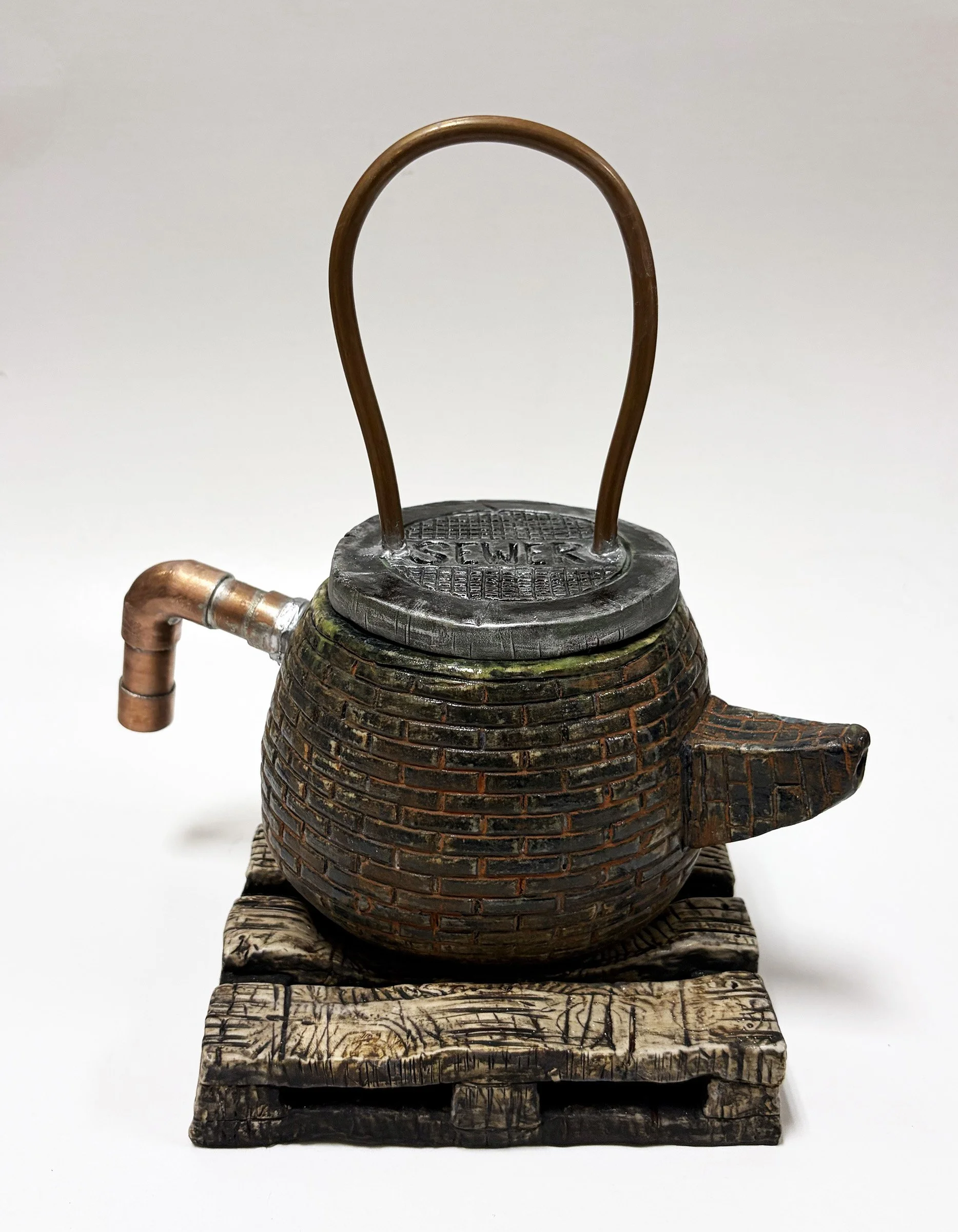
Utility Ware
I’m really happy with how this piece came together. From the beginning, I wanted the teapot to feel assembled rather than designed as one seamless object. Ceramic brick, a pallet, copper pipe, a sewer cover, glaze, and metal. each part has its own material language and its own purpose. Somehow, when they’re forced together, they become a single functioning object.
The process ended up feeling more personal than I expected. I kept thinking about Frankenstein while I was building it: taking separate pieces, making adjustments, solving one problem only to create another, and slowly figuring out how everything could coexist. There’s something about that process that feels very familiar right now. In a lot of ways, I’m doing the same thing with my life, reassembling it from pieces, figuring out what still fits, what needs to change, and what can become something entirely different.
That’s where the duality in this piece became most interesting to me. It isn’t just ceramic against copper, handmade against manufactured, or domestic object against industrial infrastructure. It’s the tension between damage and utility, fragmentation and reconstruction, instability and function.
Every material decision forced another decision. Nothing could really exist independently. The copper changed the ceramic. The pallet changed how the pot sits. The sewer cover changed the language of the lid. The brick surface changed the way I thought about the spout. Instead of trying to hide those transitions, I leaned into them.
And somehow, after piecing all of this shit together, it works.
Utility Ware
Ceramic, glaze, copper, mixed media
2026